Appetite for Survival
From wet markets to dai pai dongs: tracing hunger and sustenance
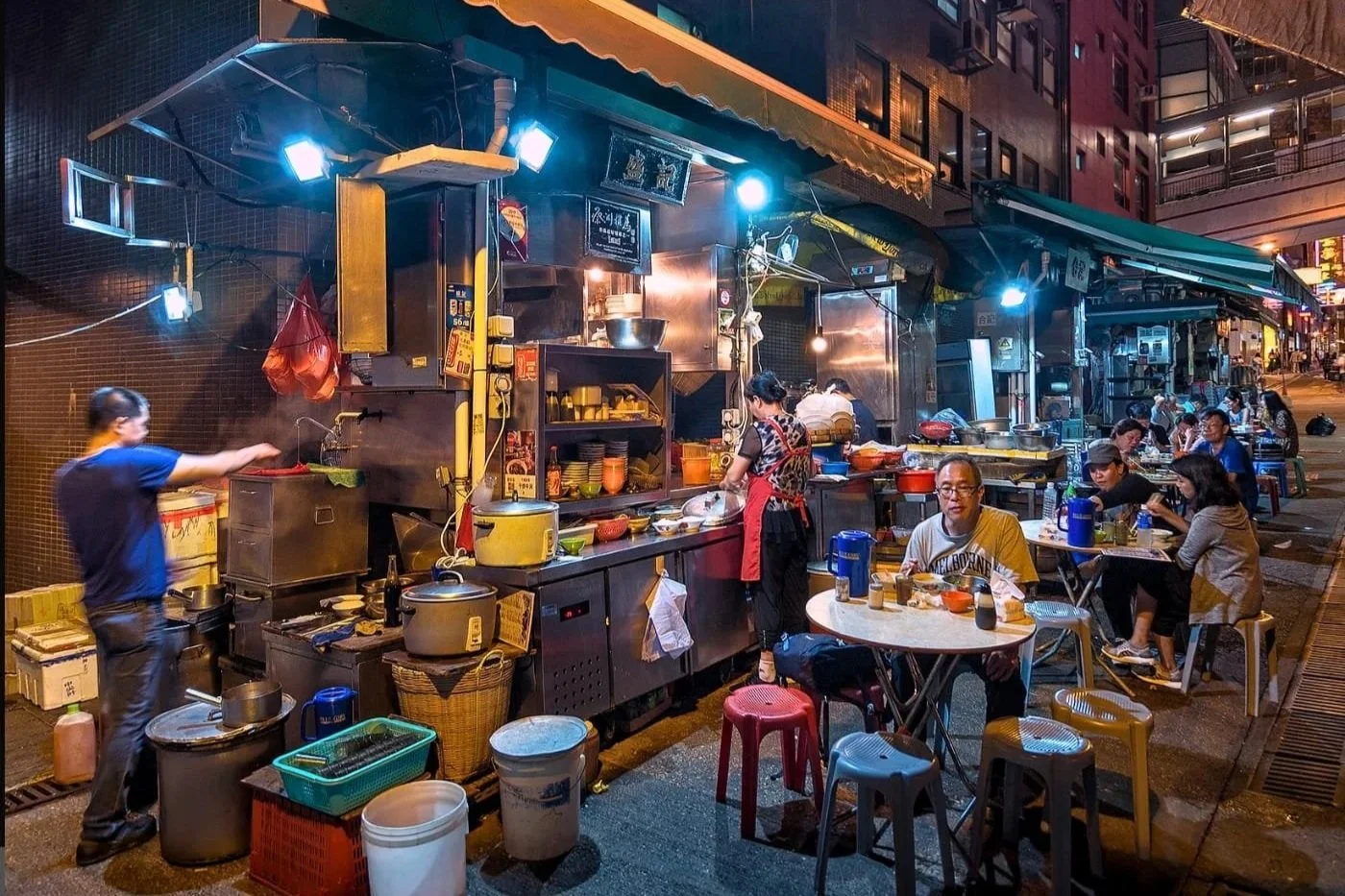
Tables wobble, flavours don’t (source: Honey Combers)
A wet market opens in the dark, hours before anyone eats. By the time a dai pai dong two streets over fires up its wok, the fish, salt, and greens on that stall have already changed hands three or four times, hauled off a boat, weighed, taxed, argued over.
Walk far enough into Hong Kong's wet markets, dai pai dongs and reclaimed shorelines, and every stall, alley and street sign becomes a reading list. Each one records hunger: who fed the city, who profited from feeding it, and who the colonial government tried to erase.
Long before "food paradise" became a tourism slogan, Hong Kong's kitchens were solving a harder problem: how to feed a crowded, resource-poor port on the edge of survival.
This instalment in the culinary series traces how that hunger built the city: the fishing grounds and salt routes that fed it first, the colonial licences and market laws that tried to control it, and the epidemic and land reclamation that redrew it entirely.
The Baseline of Bite
Long before colonial planners drew a single street, Hong Kong's coastline, farmland, and folklore were already dictating how the region ate. Boat-dwelling communities named the water by what lived in it. Inland, rural markets rose and emptied with the harvest, generations before the Union Jack arrived. Even the region's legends: sweet potatoes fed to a fleeing emperor, a sacred island shaped like a melon were food stories first.
Net Profits
Before land reclamation reshaped the harbour, boat-dwelling Tanka and Hoklo communities mapped marine life onto local geography, naming coastal features after their daily catch: Tsing Yi 青衣 (“Black Tuskfish”), Lung Ha Wan 龍蝦灣 (“Lobster Bay”), and Yau Yue Wan 魷魚灣 (“Squid Bay”). When the Tanka anchorage of Shek Pai Wan urbanised in the 1960s, planners formalised this heritage through thematic lanes like Yue Fung Street 漁豐街 (“Abundant Fishing Street”) and Yue Wok Street 漁獲街 (“Fish Catch Street”).
Fishing practices shaped place names too. Yau Ma Tei 油麻地 reflects pre-nylon gear preparation: crews wove heavy hemp nets (ma, 麻) and sealed them with boiling tung oil (yau, 油) against rot. Though the water retreated, this landlocked neighbourhood preserves its trade legacy.
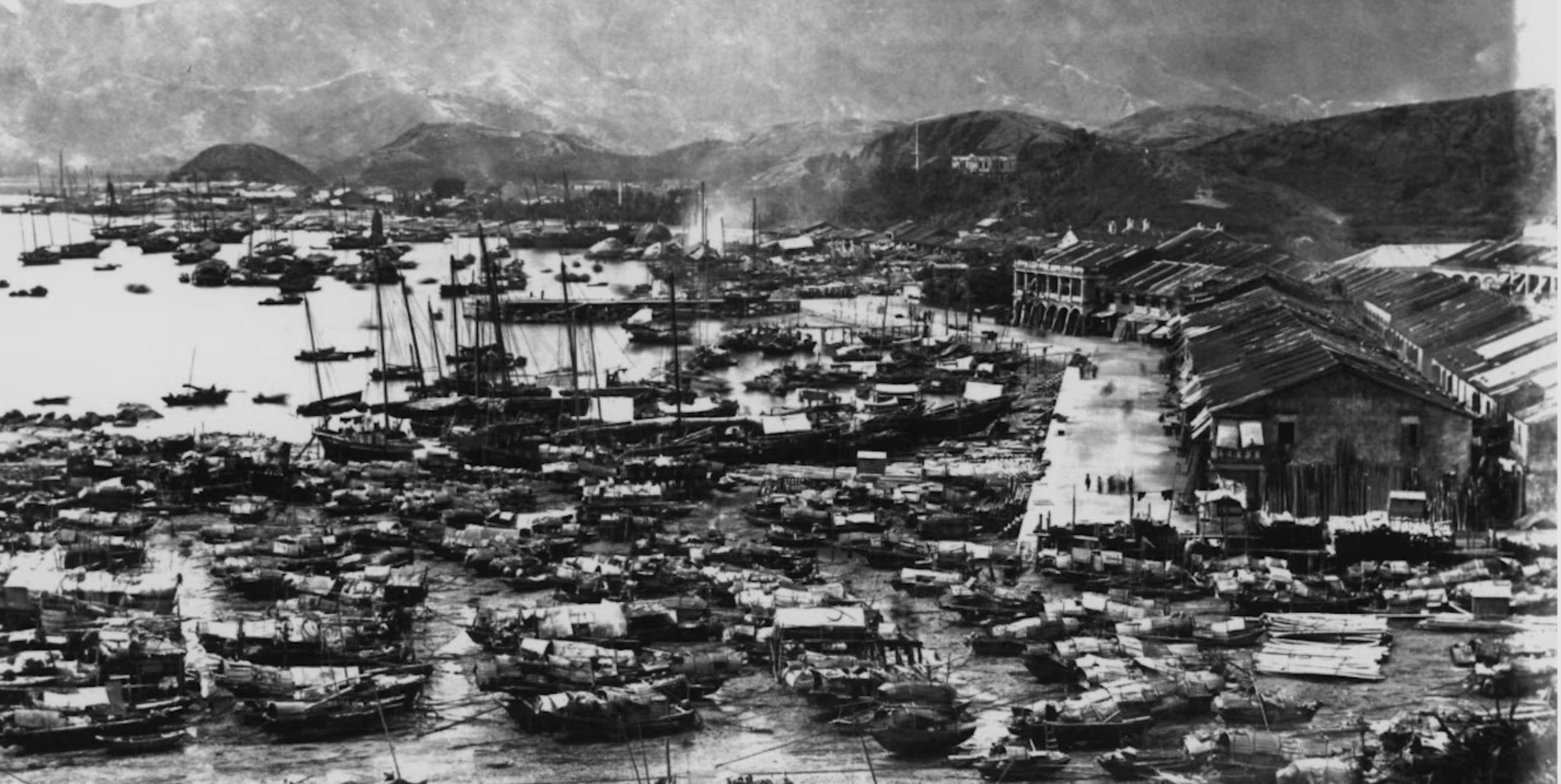
Shore of Yau Ma Tei in 1922 (source: The Conservation)
RIP icon (source: SCMP)
On Lamma Island, Sok Kwu Wan 索罟灣 honours mooring ropes (Sok 索) and nets (Kwu 罟). Offshore, Mong Yue Kok 望魚角 (“Watch Fish Corner”) recalls cliffside scouts tracking schools, while Cha Yue Pai 炸魚排 (“Bomb Fish Raft”) is locally remembered as "Blast Fish Raft," a name associated with the illicit era of dynamite fishing rather than its more literal reading of "fried fish raft." Through these names, contested etymologies and all, the modern coastline remains a working archive of survival and appetite.
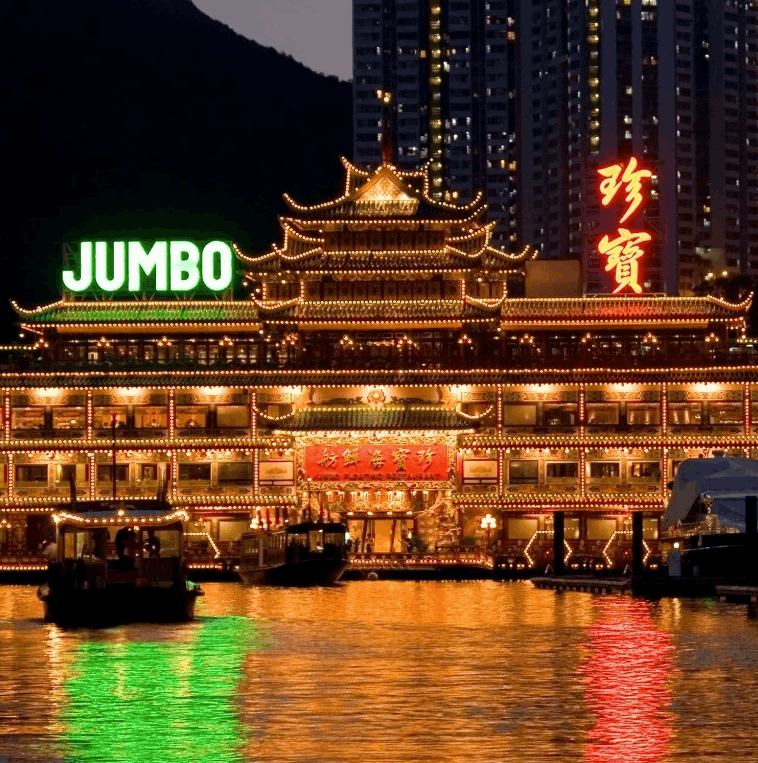
The Tai Pak Floating Restaurant 太白海鮮舫 (1950) and Jumbo Kingdom 珍寶王國 (1976) carried this waterborne heritage into spectacle — tracing their roots to 1920s Pearl River "Songhall Boats" 歌堂船, where Tanka families hosted musical banquets on barges. By its own account, Jumbo hosted more than 30 million visitors across 44 years, with guests ranging from Queen Elizabeth II to Tom Cruise, and it even staged the climax of Stephen Chow's The God of Cookery. When Jumbo was towed away in June 2022 and capsized near the Paracel Islands days later, it looked like the final chapter of Hong Kong's floating restaurant culture. Tai Pak, its smaller sister vessel, tells a different story: after changing hands in 2022, it has spent the years since under renovation at Aberdeen, running sea tours and tastings in the meantime, with a full reopening targeted for the second half of 2026, a reminder that this chapter of the map is still being redrawn, not just remembered.
Markets of Emptiness
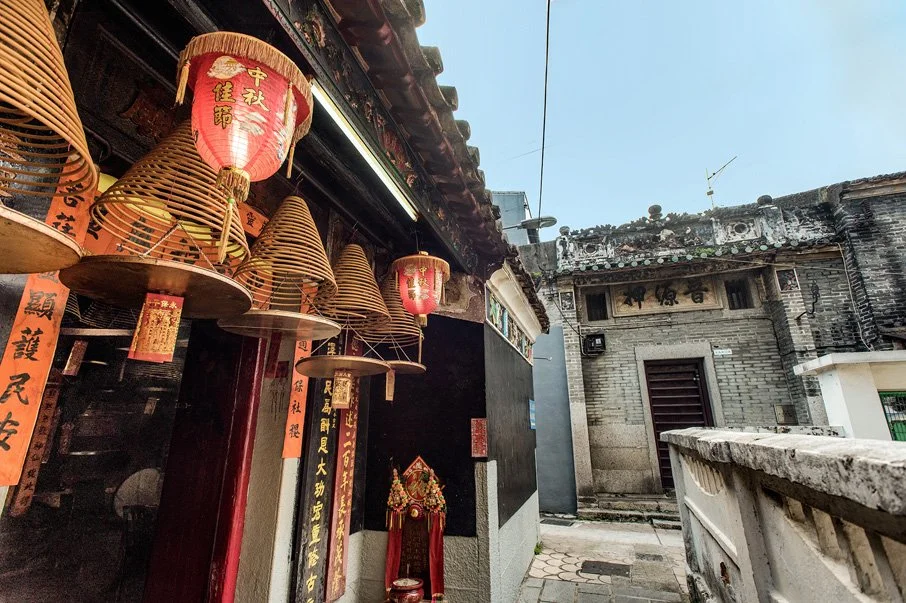
Yuen Long Old Market, founded in 1669, once served as the district’s primary trading centre (source: Hulu HK)
Inland Hong Kong’s commercial geography followed agricultural harvest rhythms. The Chinese character for these rural markets, hui (墟), shares a root with emptiness (虛), capturing their temporal nature. As the Qing-era text Guangdong Xinyu (廣東新語) observed:
"In Guangdong, a rural market is called hui. When people gather, it is full; when they disperse, it is empty. Fullness is rare, emptiness is common—hence the name."
「粵謂野市曰虛。市之所在,有人則滿,無人則虛。滿時少,虛時多,故曰虛也,虛即廛也。」
The legacy of this rhythm survives in Yuen Long Old Market. Evolving from Ming-era roots, the Tang clan formally established Yuen Long Kau Hui in 1669, hardening this temporal hub into a permanent grid of ambition: Cheong Shing Street 長盛街 (“Long Prosperity Street”), Lei Yik Street 利益街 (“Profits Street”), and Wine Street 酒街. By the 19th century, nodes like Yuen Long Hui 圓蓢墟 had become vital engines of exchange, their narrow lanes crowded with inns, wine houses, and grain firms.
These commercial arteries fuelled local food traditions, supplying ingredients to turn rural surpluses into legendary walled village 圍村 Poon Choi 盆菜 ("Basin Meals"), a dish now served at wedding banquets and New Year feasts across the territory, one of the few Ming-era market habits that still reaches a Hong Kong table intact. One popular account roots the dish in Song Dynasty refugee lore, though like much of Hong Kong's culinary folklore, its exact origin is debated rather than settled. What's better documented is the dish itself: staples like radish, pig skin, dried eel, squid, pork, and bean curd stacked to absorb the rich juices of luxury additions above. As market wealth grew, affluent families like the Tangs expanded this tradition into lavish "Nine-Dish Banquets" (Gau Daai Gwai, 九大簋), serving delicacies in individual porcelain rooster bowls.
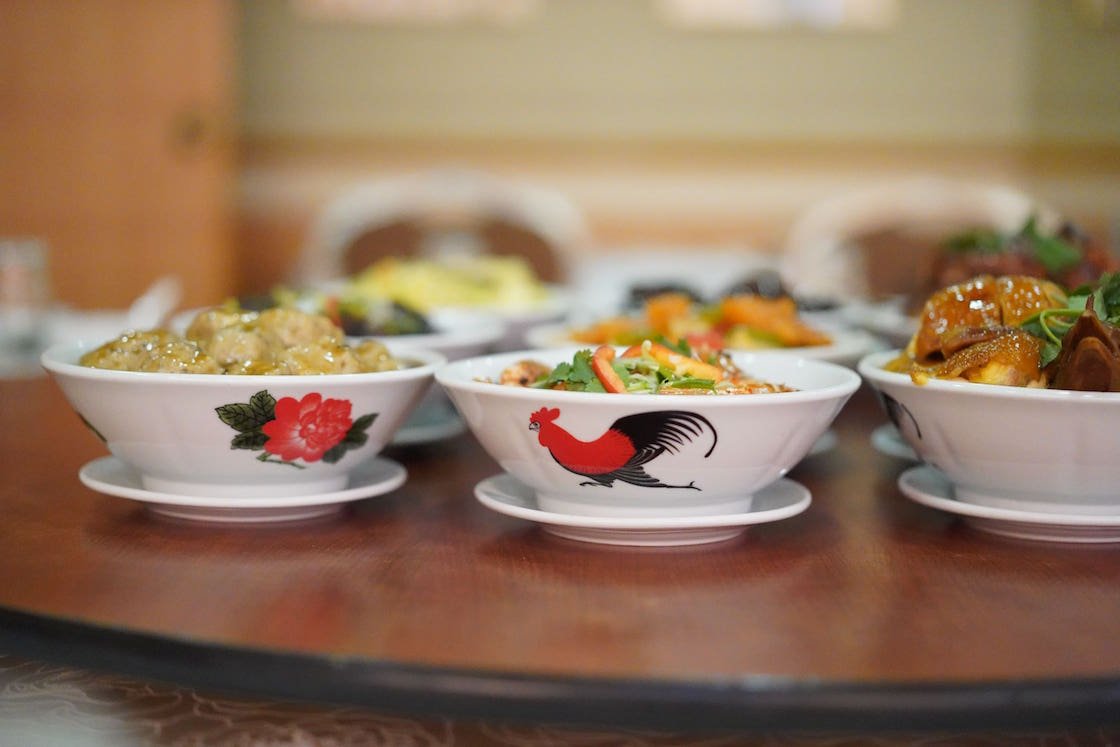
Nine dishes of "gau dai gwai" in rooster bowls (source: Michelin Guide)
Rooted in Myth
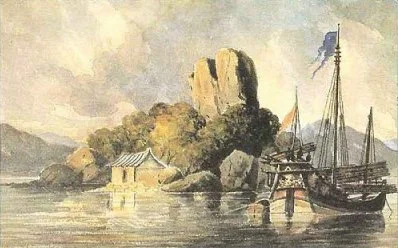
Hoi Shum Island in the 1840s, now reclaimed (source: wiki)
Further east, To Kwa Wan 土瓜灣 connects an imperial legend with the region's ancient geography. Local folklore claims villagers fed sweet potatoes to the fleeing Southern Song Emperor Duanzong in 1277 while he took refuge near neighbouring Sacred Hill (聖山). However, the South American tuber had not yet arrived in China. The name actually honours the to kwa (土瓜), a native greater yam cultivated across the local coastal plains — a case where the district's most-repeated legend and its actual linguistic root tell two different stories, and only one of them survives in the character on the street sign.
This agricultural landscape was mirrored offshore by To Kwa Wan Island (Hoi Shum Island), a small, melon-shaped granite outcrop venerated by Tanka fishermen as a sacred sanctuary. While 1960s industrial land reclamation eventually erased the surrounding sea, the island's iconic Hoi Shum Rock 海心石 and Fish Tail Rock 魚尾石 were preserved inside modern Hoi Shum Park (海心公園), leaving an ancient geological remnant stranded inside a concrete neighbourhood.
Salt Economy
If fish was Hong Kong's first appetite, salt was its first tax. For two thousand years before the British arrived, whoever controlled salt controlled the coast, and the fight over it left both blood and bureaucracy etched into the map.
Worth Their Salt

Salt worker in Tai O (source: Industrial History HK)
Preserving hauls in a punishing subtropical climate demanded Hong Kong’s oldest state‑controlled enterprise: salt. For over two millennia, the salt trade was heavily taxed and regulated across Imperial China, where the court managed the coastline through government pans, treating the condiment as fiscal currency.
The imperial presence remains etched into the contemporary map. In the Northern Song dynasty the area now called Kwun Tong 觀塘, literally “View Pond” was recorded as 官塘 (“Official Pond”). That near‑homophone likely softened an overtly bureaucratic name over time, and the district once functioned as Kwun Fu Cheung 官富場 “Official Government Wealth Field.”
Because salt functioned as liquid tender, these outposts became lucrative, dangerous frontiers. In 1197, under the Southern Song dynasty, fiscal tension erupted into open warfare in Tai O 大澳. When Lantau’s independent salt-makers defied the imperial monopoly, brutal clashes with dynastic enforcers ended in the massacre of more than three hundred workers.
Other remnants lie scattered across the coast, from Yim Tin Tsai 鹽田仔 (“Small Salt Pan”) in Tai Po to Yim Liu Ha 鹽寮下 (“Below the Salt Depot”) in Sha Tau Kok. The British colonial government extended this tradition of state control in 1844 by introducing its own short-lived salt tax. Through centuries of dynastic shifts and colonial governance, these toponyms preserve a time when the foundational seasoning of Hong Kong's kitchens was a matter of state revenue and bloody rebellion.
Scents and Sensibility
Salt gave Cantonese cuisine one of its defining flavours: ham yu (鹹魚, salted fish). Originally essential fuel for manual labourers stretching plain rice with a single, pungent fragment, immortalised in the idiom “eat salted fish, endure the thirst” (食得鹹魚抵得渴), its deep umami eventually entered grand banquet halls.
By 1858, Sai Ying Pun controlled nearly 60% of Hong Kong’s fish stalls, formalising shoreline trading into Ham Yu Street 咸魚街 (“Salted Fish Street”). Late-1880s reclamation landlocked these brine-soaked workshops, creating dense, unsanitary conditions. When bubonic plague struck in 1894, colonial authorities declared the alley a biohazard and demolished it entirely.
Redevelopment brought a shift in urban semiotics. Authorities renamed the new paths Mui Fong Street 梅芳街 (“Plum Fragrance”) and Kwai Heung Street 桂香街 (“Osmanthus Fragrance”), substituting floral names to mask the pungent reality of the mui heung (霉香, "mould-fragrant") fish cure. Planners buried a prized fermentation process beneath an aromatic fiction. Still, a downscaled Ham Yu Street 咸魚街 survives nearby, preserving Sai Ying Pun's sensory memory. There, the unmistakable scent continues to perfume the air above dried seafood shops and local kitchens serving Claypot Salted Fish and Minced Pork Claypot Rice (鹹魚肉餅煲仔飯).

Dried seafood shop in Sai Ying Pun (source: TimeOut HK)
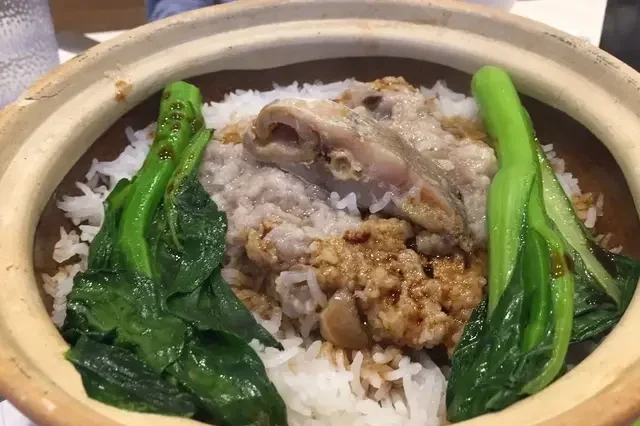
Claypot rice with salted fish (source: Open Rice)
The Colonial Shift
Colonial Hong Kong grew almost none of its own food; it inherited and captured someone else's supply chain instead. What began as a blockade-busting black market on the water hardened, within a few decades, into licences, permits, and walled markets on land.
Floating Assets
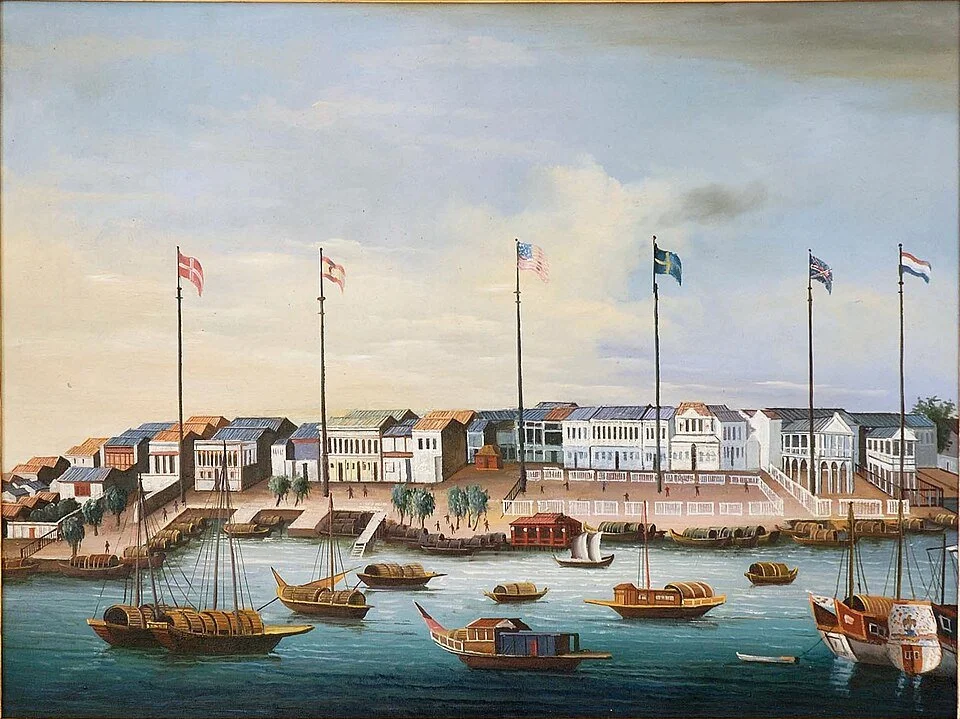
The Port of Canton in 1830s (source: wiki)
Hong Kong’s food supply originally relied on a precarious maritime network. Under the Canton System, Western merchants sourced provisions through officially appointed Chinese compradors. When geopolitical tensions escalated in 1839, Commissioner Lin Zexu weaponised this dependence, blockading Macau to starve British forces back onto their ships.
This imperial embargo inadvertently birthed a sprawling shadow economy. Defying Qing threats of execution, local boatmen leveraged ancestral maritime networks to provision the blockaded fleet. Bumboats and sampans transformed the anchorages of Victoria Harbour, Tung Kwu (Lung Kwu Chau) 龍鼓洲, and Kap Shui Mun 汲水門 into a vast, floating black market. Some 2,000 vessels worked the anchorage at its peak, described in period accounts as a "floating Wapping," after London's own riverside black-market district.
As the colonial presence solidified, this waterborne economy washed ashore, laying the foundations for Hong Kong's earliest landward bazaars. Tsim Sha Tsui became a vital funnel for mainland vegetables, whilst coastal operators bartered cattle and poultry, frequently exchanging livestock for Bengal opium. The missionary Karl Gützlaff documented this aggressive open-air provisioning. His legacy survives geographically in Gützlaff Street 吉士笠街 in Central, a narrow, sloping lane beside Graham Street Market, where the frantic rhythms of this early shadow economy remain.
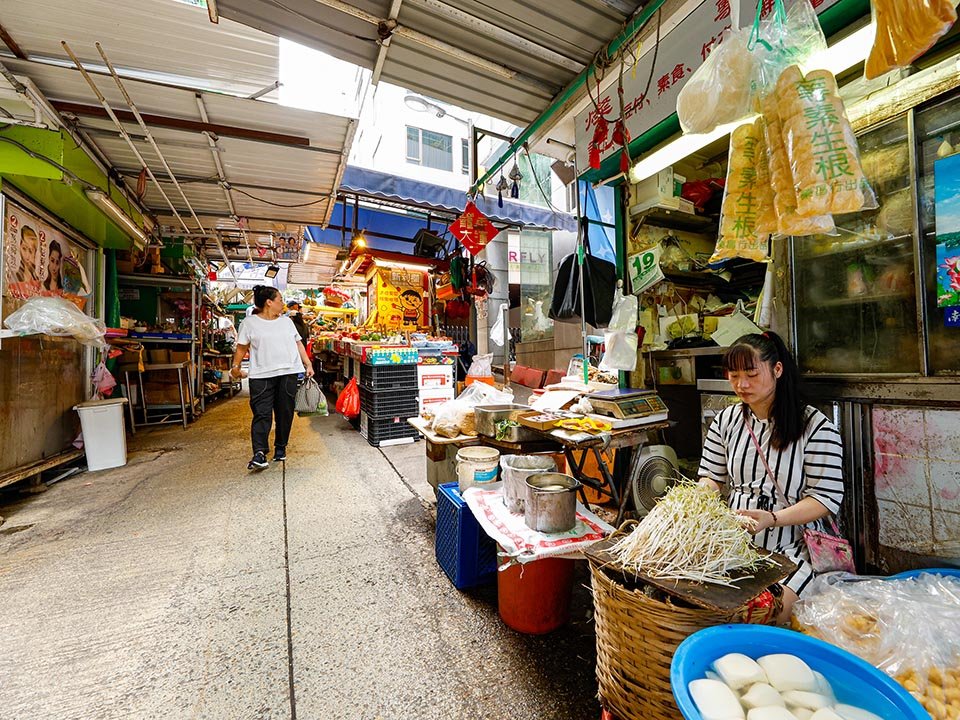
Graham Street market, one of the last standing open air markets in Hong Kong (source: HK Tourism Board)
The Birth of the ‘Big License’
With Britain’s 1841 occupation of Hong Kong, the food supply came ashore. Pearl River Delta traders poured in, and within months, 600 hawkers crowded Queen’s Road. The colonial government introduced a regulatory framework in 1847 to manage this congestion, establishing the administrative foundation for formal street dining.
The true Dai Pai Dong 大牌檔 emerged post-WWII amidst wartime devastation and refugee influxes. To boost employment while controlling street vending, the Urban Council issued special cooked-food permits to fixed stalls. Authorities mandated that operators frame and display an oversized paper permit detailing stall coordinates and licensee details directly on the structure. This prominent "big licence" 大牌 (dai pai) gave these open-air kitchens their legendary name.
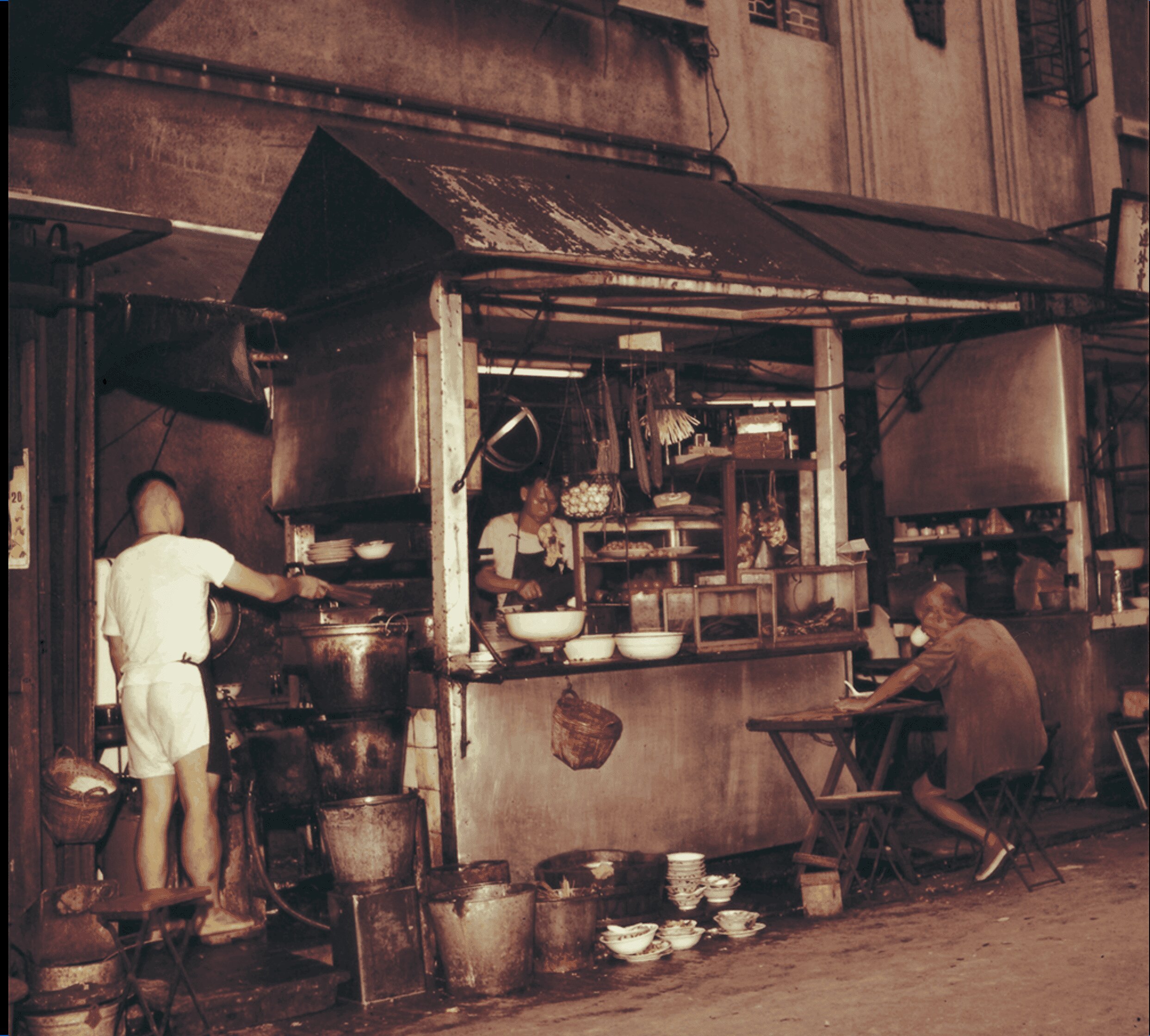
A dai pai dong, or “big licence stall”, in the early 1960s (source: HK Memory)
Bound to fixed pavement plots, vendors erected distinct green-canvas structures. Roaring kerosene fires delivered the essential wok hei 鑊氣 (‘breath of the wok’) required for Stir-fried Beef Ho Fun (乾炒牛河), while cheap, high-energy refreshments like Silk Stocking Milk Tea (絲襪奶茶) and Yuenyeung (鴛鴦) sustained manual labourers through gruelling shifts.
Beyond feeding working-class crowds, these open-air setups incubated Hong Kong’s culinary elite. Institutions such as Yung Kee 鏞記, Joy Hing Roasted Meat 再興燒臘飯店, and Kau Kee Beef Brisket 九記牛腩 all trace their roots to humble roadside stalls before establishing permanent dining empires.
In 1972, the government stopped issuing new licences, systematically dismantling the open-air grid. Stalls moved into municipal cooked-food centres or indoor shopfronts, though landmarks like Lan Fong Yuen 蘭芳園 in Central retained original street counters. By 2005, a mere 28 licensed stalls survived across historical pockets in Central, Tai Hang, and Sham Shui Po, preserving the sensory memory of Hong Kong’s open-air past.
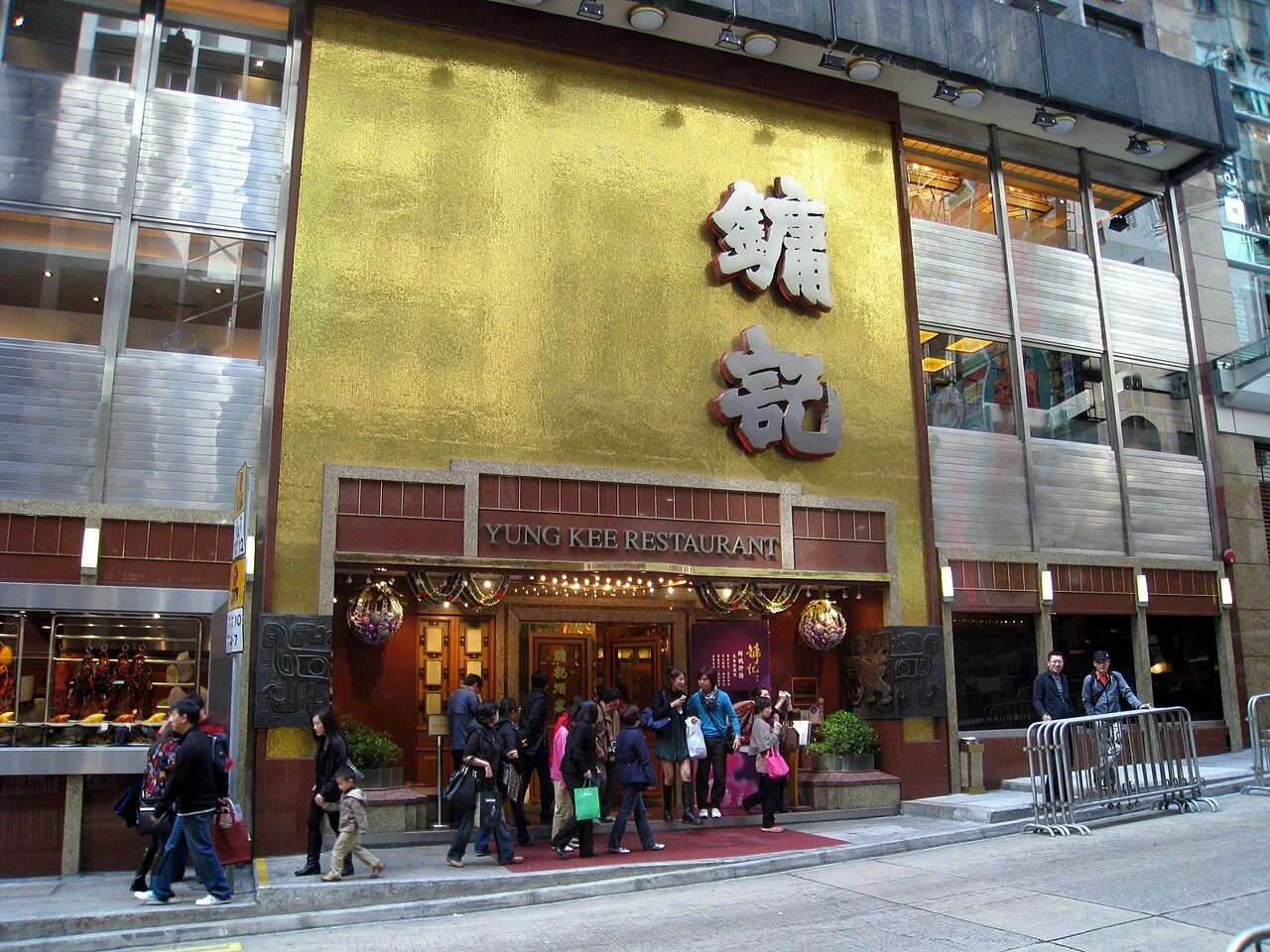
Yung Kee Restaurant - where the rich and famous get their roast goose (source: wiki)
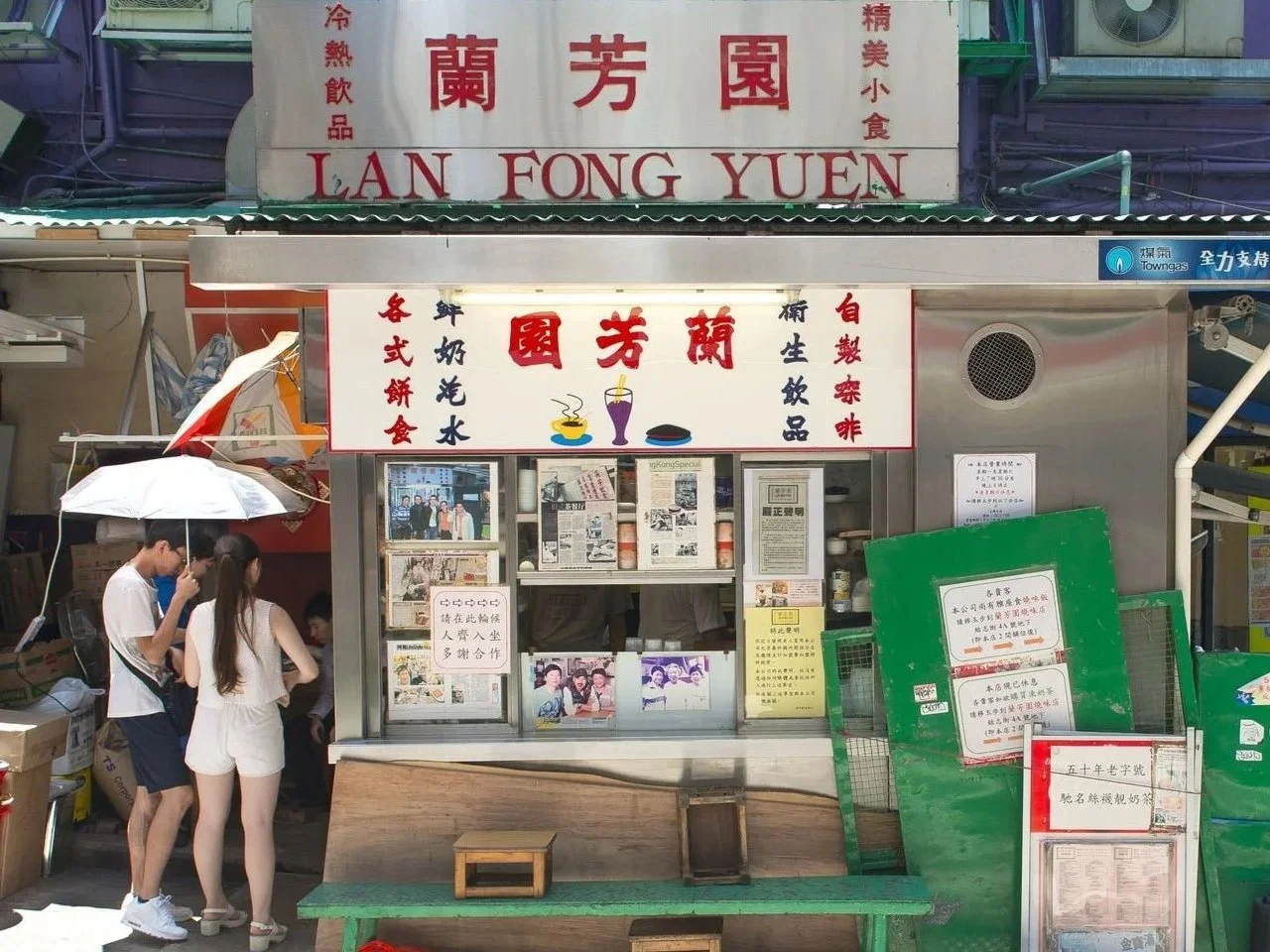
Lan Fong Yuen - one of the remaining dai pai dongs in Central (source: Landmark)
Zoning the Chaos
Determined to sanitise an overwhelmingly organic food economy, the colonial administration partitioned the Chinese population into designated Bazaars in Sheung Wan. To combat chaotic hawkers and open-air butchers spilling onto thoroughfares, the government deployed strict street-hawking bans alongside heavily regulated public markets.
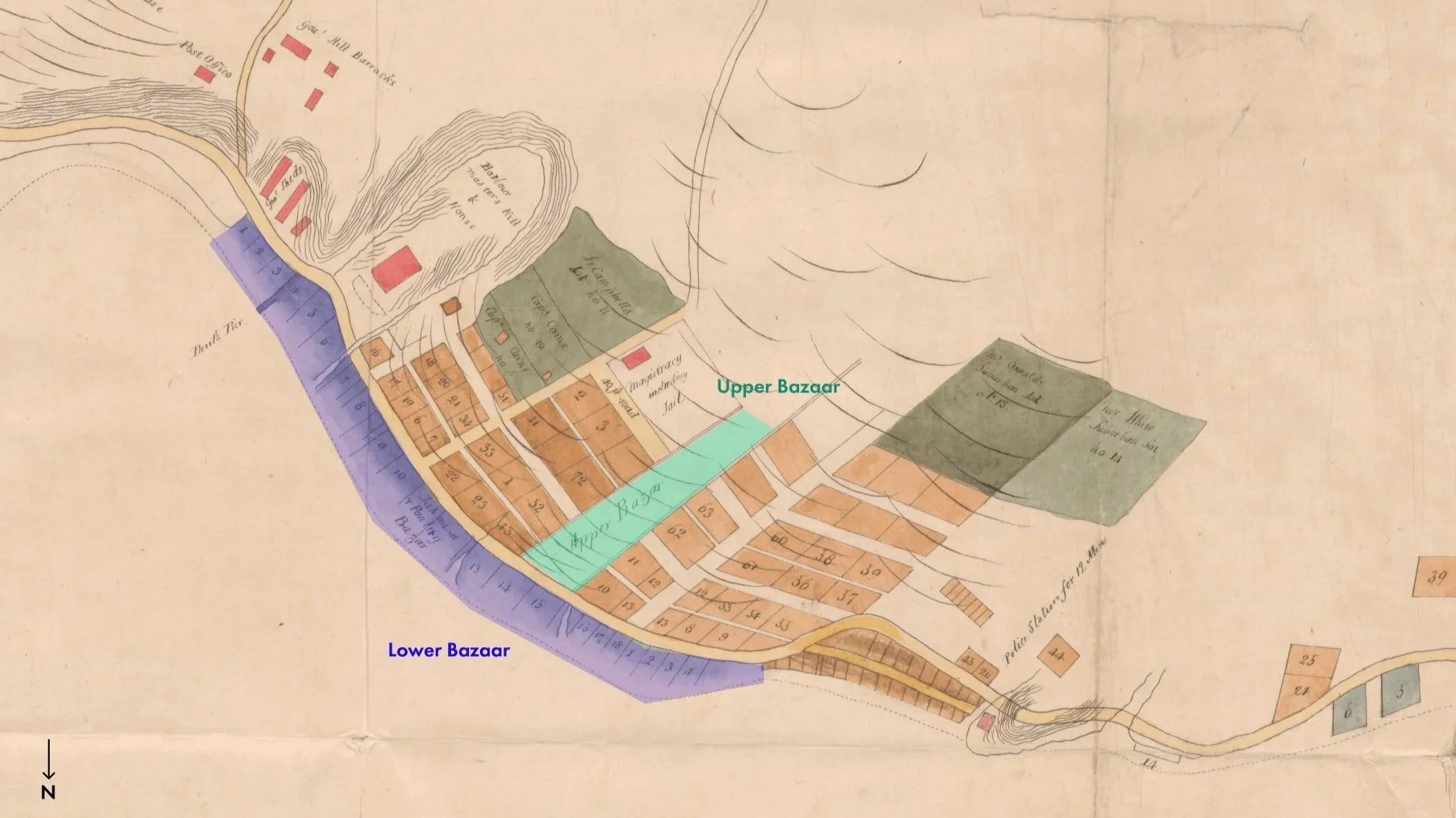
Check out the 1842 Plan of Hong Kong on HK Maps to see where this is in present day (source: UK National Archive)
At the center of this system stood Central Market, opened in 1842 on Marine Lot No. 16. Positioned at the hinge between the Upper and Lower Bazaars, its walled rectangle faced the Praya, physically intercepting provisions arriving by boat and foot traffic along Queen’s Road. This fortress of commerce represented the colony's first purpose-built attempt to drag the raw, blood-and-brine provisioning trade off the street grid into a controlled, taxable space. Eastern Market followed in 1844 near Arsenal Street, and Western Market in 1858. These architectural interventions systematically swept raw fish, vegetable, and meat trades out of alleys and behind sterile colonial walls.
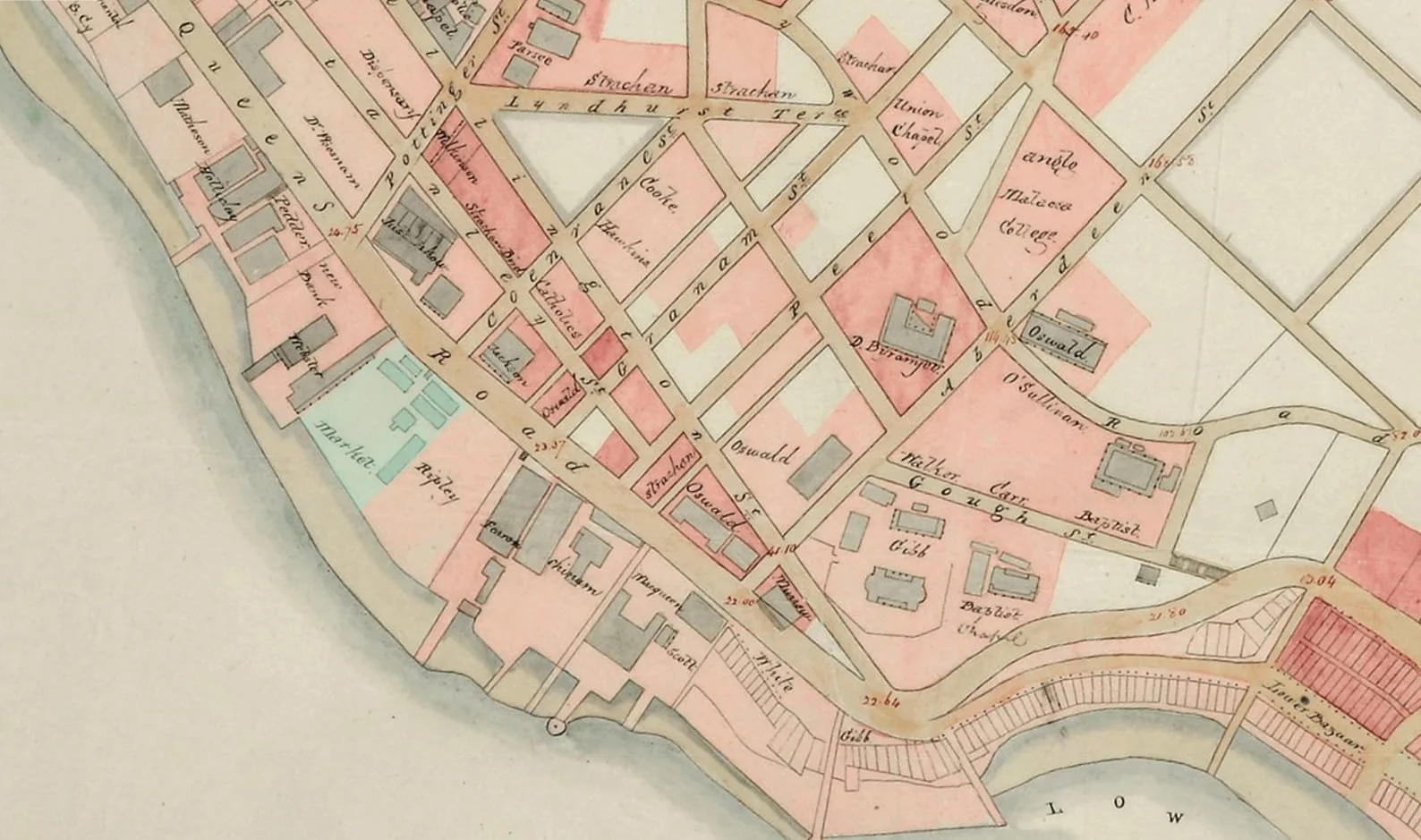
Map showing Central Market in 1845 (source: UK National Archive via HK Maps)
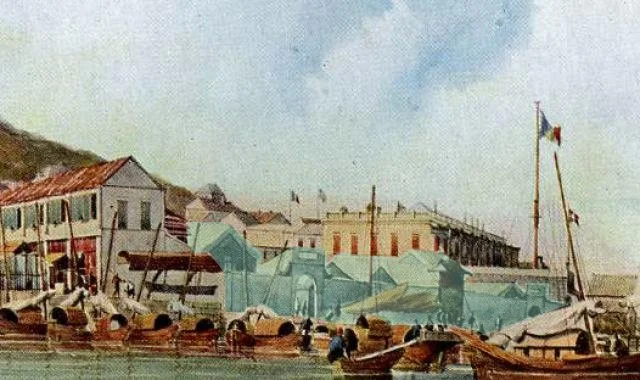
Oil painting of the walled-Central Market next to P&O headquarters around 1851 (source: Gwulo)
Oligarchs of Flesh
In 1844, the administration cleared the ad‑hoc Middle Bazaar, moving the Chinese population uphill into Taipingshan. To operationalise municipal markets without public funds, Governor John Davis introduced 'market farming,' auctioning off exclusive operating and taxing rights, colonial Hong Kong outsourcing its own infrastructure before it had a word for the practice. The policy created a new class of wealthy Chinese food oligarchs.
Loo Aqui 盧亞貴, a Tanka man who parlayed wartime British provisioning into land rewards, secured a foothold at the Lower Bazaar. Kwai Wah Lane 貴華里 in Sheung Wan still bears his alias. From this base, he built a property empire funded by gambling dens and brothels, co‑founding Man Mo Temple before speculative losses bankrupted him by 1855.
Securing live cattle from the mainland was a high‑stakes trade dominated until the 1870s by Kwok Acheong, recorded in different documents under several names and aliases: 郭甘章, 郭亞祥, 郭松 and nicknamed Ngau Lan Atsung (牛欄阿松, "Cattle Market Atsung"). Kwok similarly transitioned from Tanka provisioning to a massive shipping empire, becoming the colony’s largest individual ratepayer. His corporate legacy endures on the map through Fat Hing Street (發興街), named after his company, though A Chung Lane 郭松街 has since vanished.
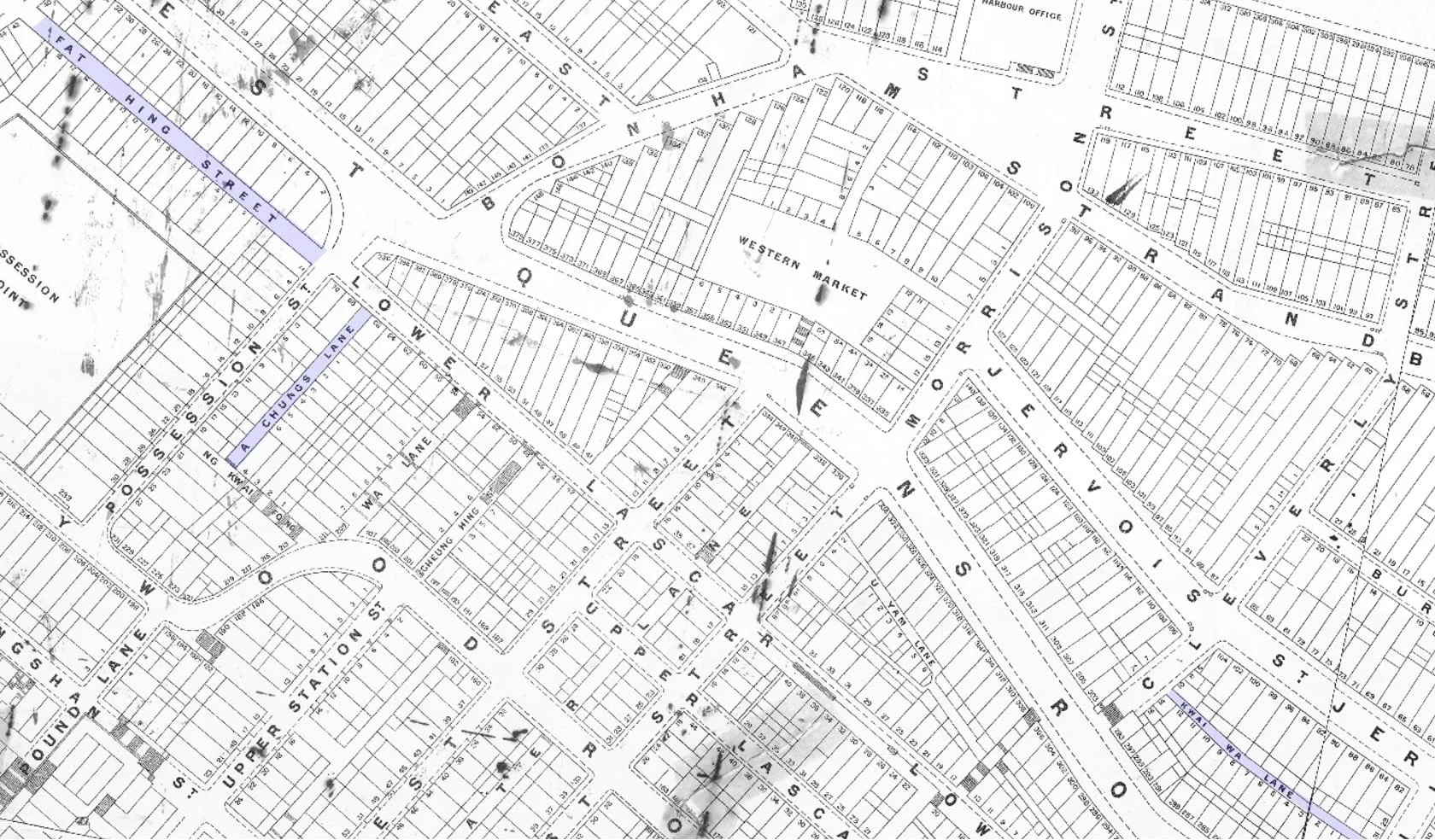
1901 plan of Victoria showing the three streets named after Loo Aqui and Kwok Acheong (source: HK Maps)
Purge of the Map
Appetite came with a body count. As livestock and food trade crowded into tenement slums, colonial Hong Kong's deadliest epidemic was, in part, a hunger crisis in disguise. Its aftermath rewrote the map as thoroughly as it rewrote public health law.
Living Stock
Tycoons like Kwok Acheong amassed fortunes commanding the cattle pipeline from comfortable shipping offices, completely insulated from the landward urban crises triggered by their livestock. As meat and dairy spoiled quickly in the heat, livestock remained alive until the very moment of slaughter. Traders dragged cattle and pigs directly into ground-floor tenements, turning them into urban barns where livestock stood tethered in darkness beneath the cramped cubicles of labourers.
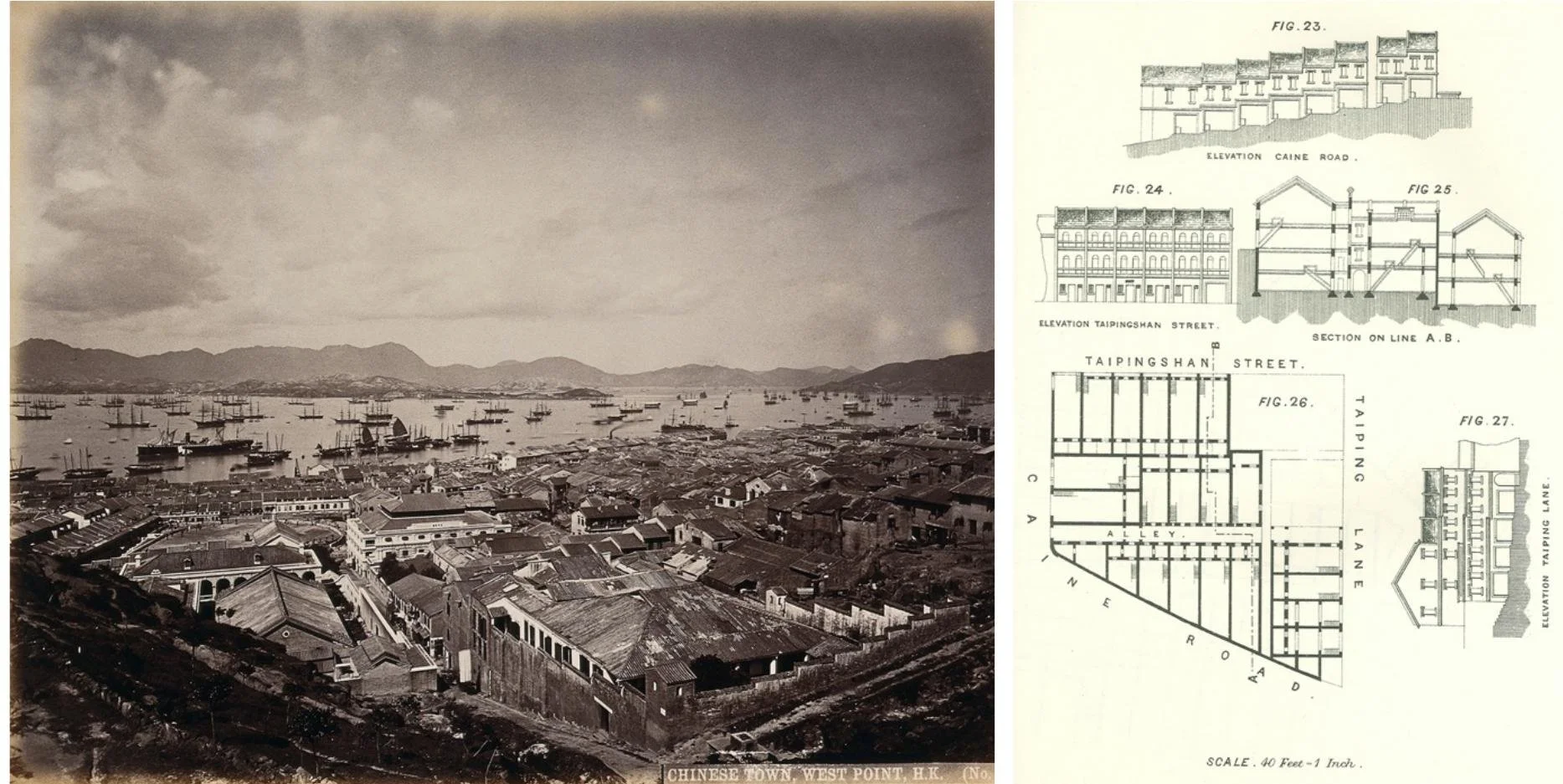
A view of the Chinese tenements in the city of Victoria, 1870s and drawings showing typical configurations of Chinese tenements in Taipingshan, 1882 (source: academia.edu)
Animals and people sharing a roof, in the heat, made near-perfect conditions for the 1894 bubonic plague, which devastated Taipingshan. The crisis was etched into Pound Lane 磅巷, named for the Government Pound that impounded stray livestock. In the aftermath, authorities demolished the slums, rewrote zoning laws, and exiled livestock trading to Kennedy Town, establishing centralised slaughterhouses at Smithfield 士美菲路 (named after London’s famous meat market).
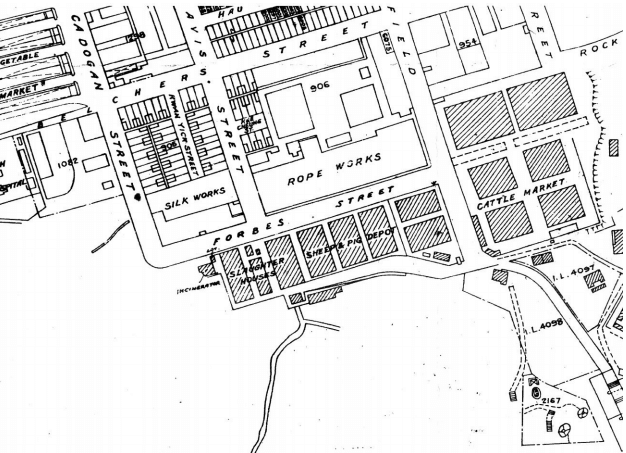
1889 map (source: Industrial History HK)
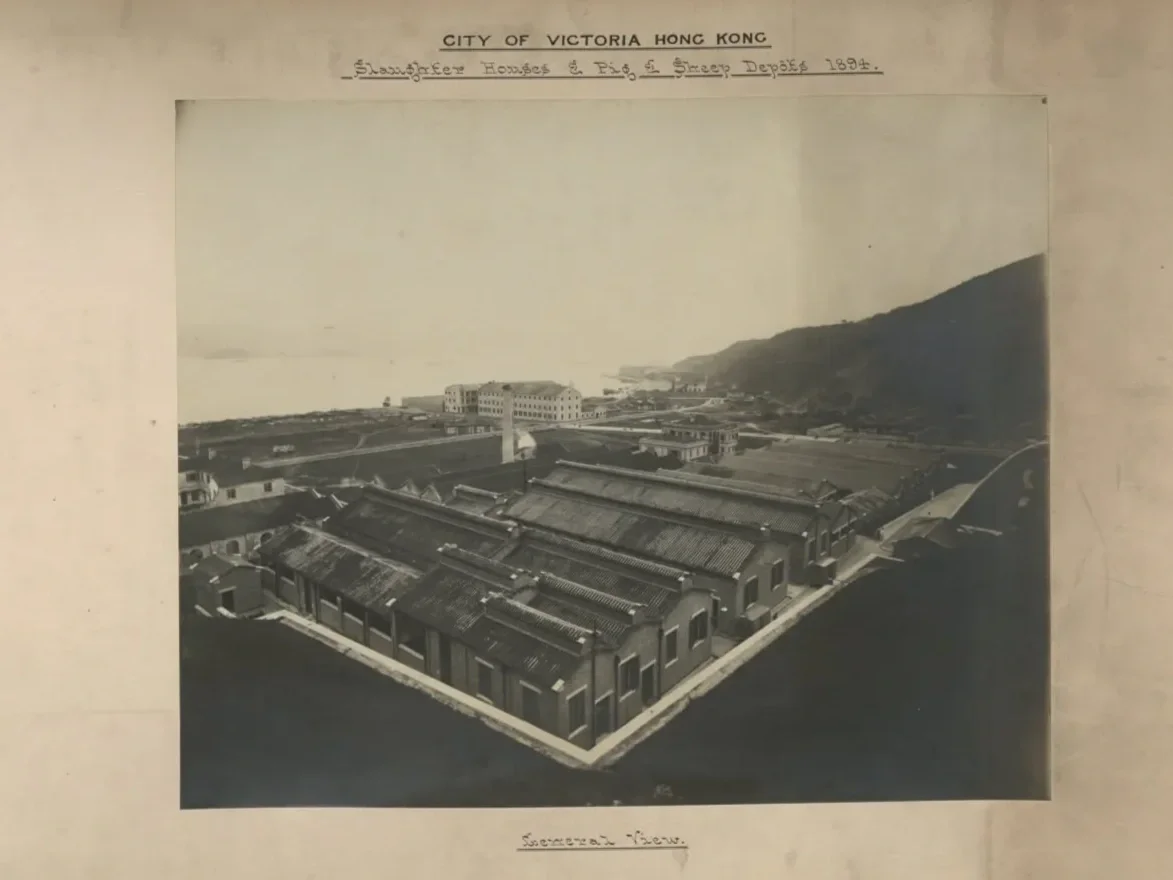
1894 photo showing slaughterhouses and pig and cattle depots in Smithfield, Kennedy Town (source: Industrial History HK)
Street Cleaning
This desire to scrub the city of its messy history extended to the map. As public markets multiplied, adjoining lanes were pragmatically christened "Market Street" (街市街). By the early 20th century, a dozen identical Market Streets created administrative headaches for postal deliveries and police patrols, prompting a systematic cartographic purge.
In Sheung Wan, the original Market Street was the epicentre of the 1894 plague. After the government demolished the tenements, the street was reborn in 1909 as Po Hing Fong 普慶坊 (“Terrace of Universal Celebration”), replacing mass mortality with forced optimism. Across the harbour, Hung Hom’s Market Street was renamed Wuhu Street 蕪湖街, replacing its market identity with a mainland Chinese city.
Today, only the Market Streets of Yau Ma Tei and Tsuen Wan survive as linguistic fossils. Western Market fronts New Market Street 新街市街, a name introduced when the government extended the market northward onto newly reclaimed land over a century ago, freezing the exact moment the colonial footprint shifted.
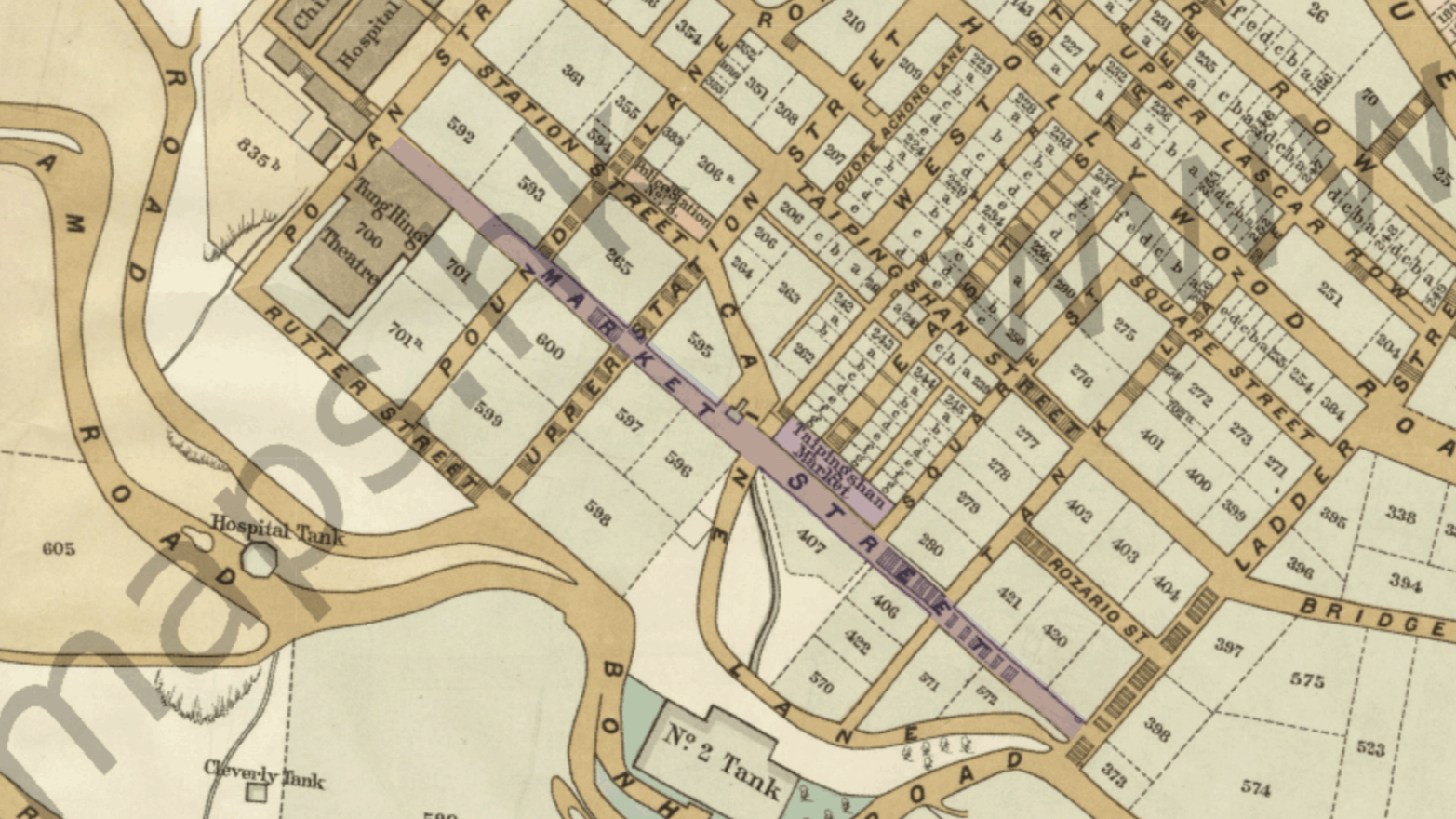
Po Hing Fong: where a plague street was rebranded as a celebration; plan of the City of Victoria circa 1889 (source: HK Maps)
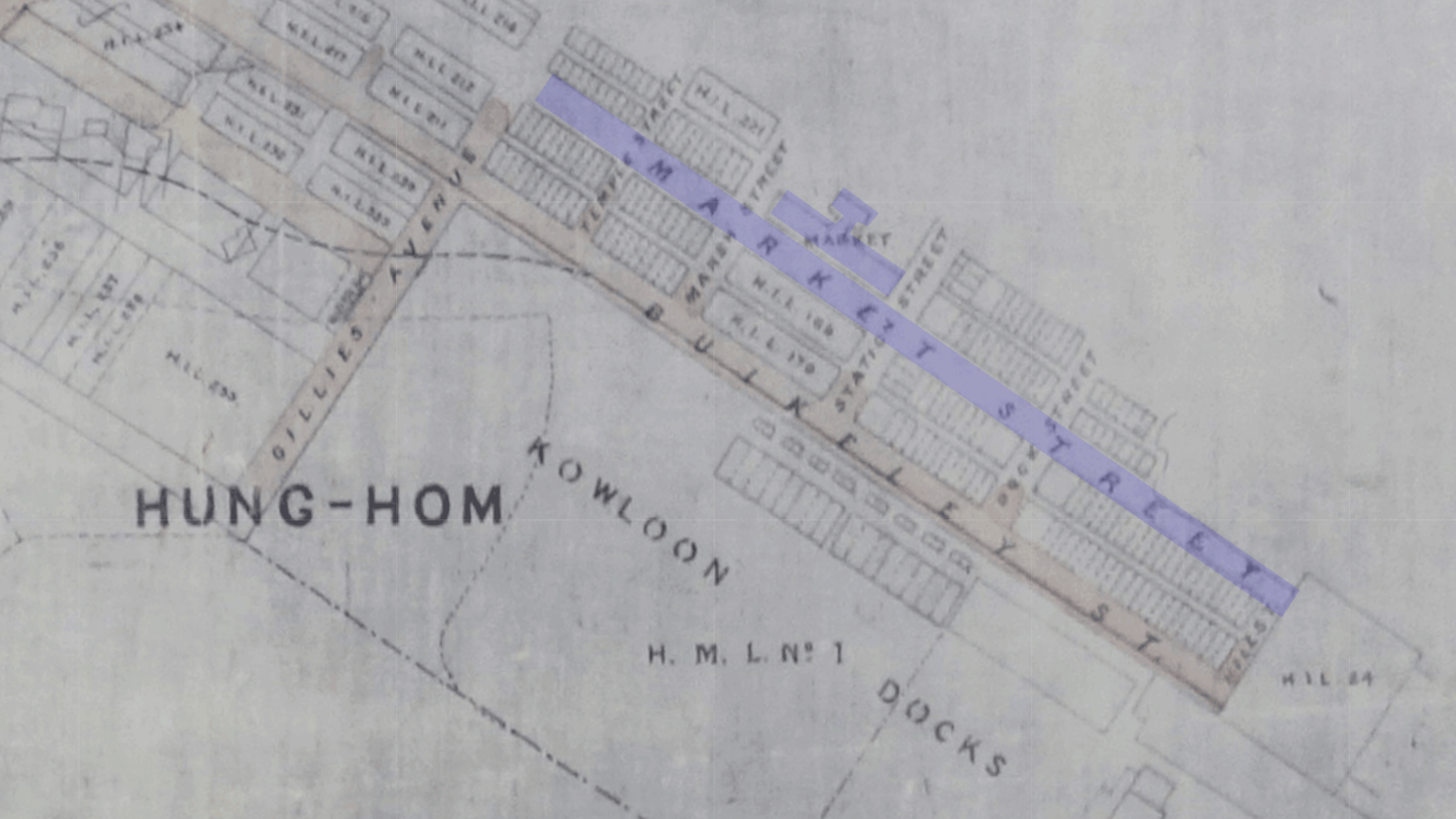
A dockyard market recast as a mainland city; plan of Kowloon Peninsular circa 1908 (source: HK Maps)
Plotting Growth
By the 20th century, survival meant manufacturing food: draining marshland into vegetable plots, terracing hillsides for refugees. This is the map's most recent layer, and the rare one you can still see standing in daylight, beyond just a street sign.
Monetise the Marshland
Before becoming one of the densest urban districts on Earth, modern Mong Kok was a coastal marshland named Mang Kok (芒角, "Corner of Fern-Gorse"). Under British administration, Chinese farmers cleared the brushland and engineered the swamps into productive market gardens to feed a growing population. When the government later paved over the area, the rectangular geometry of these water plots provided a template for developers, locking the footprint of modern streets to the dimensions of vegetable fields.
This agricultural history survives in local toponyms. Sai Yeung Choi Street (西洋菜街) marks where flooded fields grew watercress, a European herb introduced via Macau that became a staple of Cantonese lou fo tong (老火湯, slow-cooked soup). Simmered with pig's kernel, dried duck gizzards, and sweet dates, this broth served as a seasonal remedy to clear internal heat (下火) in the humid climate. Adjacent fields of water spinach inspired Tung Choi Street (通菜街). Intensive irrigation for these crops triggered mosquito concerns, prompting the colonial government to evict growers to rural districts and replace marshlands with concrete high-rises.
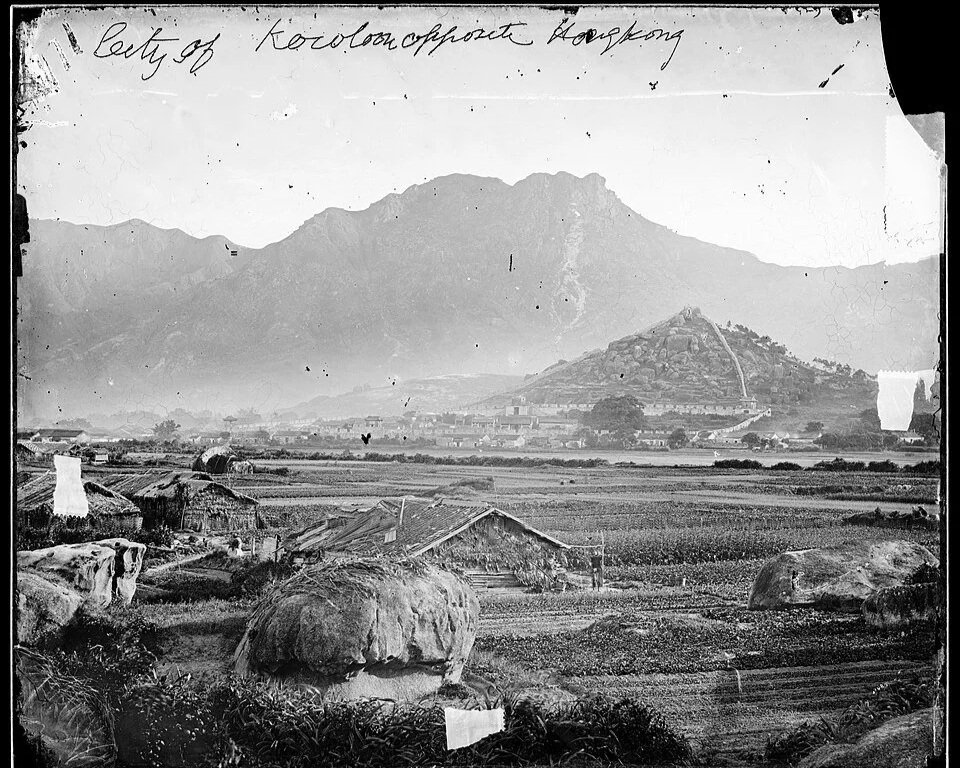
Kowloon looking towards Kowloon City in 1870 (source: wiki)
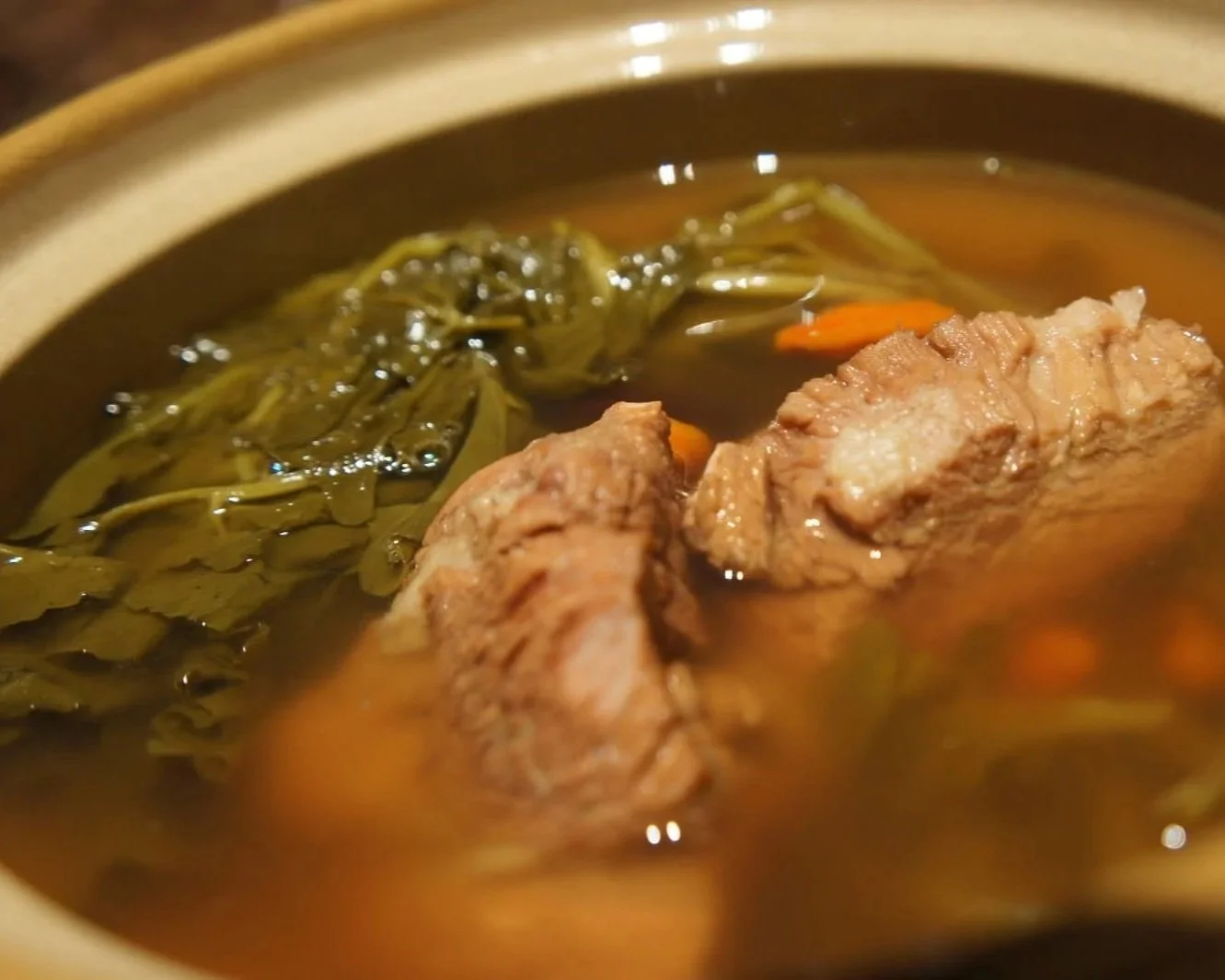
Cantonese Watercress Soup (source: Say My Kitchen)
Pigs and Pragmatism
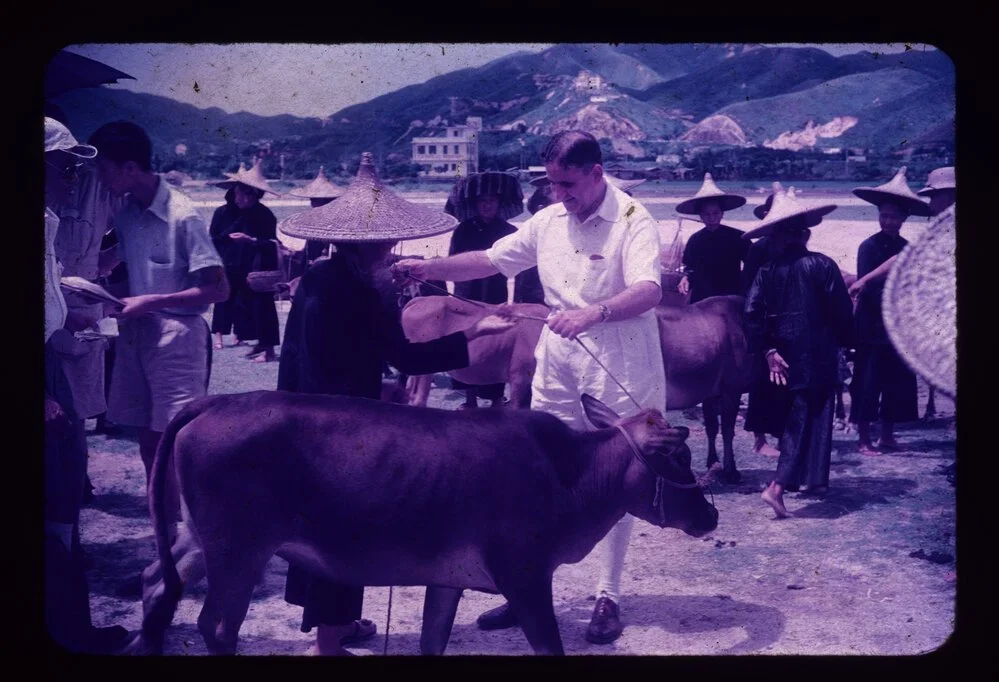
Widows being gifted cattle by Horace Kadoorie (source: HK Heritage)
After 1949, a massive refugee influx forced Hong Kong to confront a looming hunger crisis. The colony’s survival depended on turning the rugged New Territories into productive farmland. Stepping into the gap was the Kadoorie Agricultural Aid Association (KAAA), founded in 1951 by Lawrence and Horace Kadoorie.
The brothers terraced steep hillsides across Tai Mo Shan and handed refugees livestock, tools, and training instead of aid. Over the following decades, KAAA moved tens of thousands of animals into the New Territories and poured the cement for over 300 kilometres of rural roads, dams, and channels. By the 1970s, these farms supplied over half of Hong Kong’s fresh greens, securing the base ingredients for the city's wet markets.
While the Kadoorie name is associated with premium addresses like Kadoorie Avenue and Kadoorie Close, the true monument to this history lives in forgotten corners of the New Territories: abandoned pigsties, concrete footbridges, and water embankments still stamped with the KAAA insignia, marking where displaced people engineered their own survival.
Conclusion
Go back to a wet market at dawn, or a dai pai dong lighting its burner at dusk, and the same relay is still running: catch to cure to stall to wok, more or less unchanged from the version this map has been tracing. Officials spent a century trying to rename it, rezone it, tidy it into something more presentable, and mostly, the smell won anyway. Every claypot, every roast, every bowl of watercress soup is still simmering on the same stubborn map that was supposed to have covered them up.
Explore the map
In the Next Installment...
Securing food was only half the battle. As Hong Kong expanded into a dense imperial hub, absolute freshwater scarcity became its paramount existential crisis. The city’s topography permanently records this desperate hydrological engineering. Next, we map these liquid histories, from contagion-breeding urban wells to sweeping colonial catchwaters and life-preserving ice.